


You start the day with the best intentions. You know that getting enough protein throughout the day matters, so you make a conscious effort to include it with breakfast. A scoop of protein in your morning shake and you’re one step closer to reaching your daily protein goals.
And then, about half an hour later, you notice a familiar discomfort - a feeling of tightness, heaviness or bloating. Nothing extreme, but enough to notice.
When this happens, it’s easy to assume that protein powder just isn’t for you.
Protein powder and bloating: what’s really going on?
Protein powder can contribute to bloating, but the protein itself may not be the only factor.
Often, it’s worth looking at the complete formulation - including lactose, sweeteners, chemical and artificial additives - as well as the serving size and how the shake is consumed.
The answer may not be to give up on protein. It may simply be time to take a closer look at what’s included in your blend.
Why can some protein powders cause bloating?
Lactose
Whey is a dairy protein, with different forms carrying different amounts of lactose. Whey protein concentrate typically contains more lactose, while whey protein isolate is filtered further and generally contains less.
If your body doesn’t produce enough lactase - the enzyme that helps break down lactose - some lactose can remain undigested as it moves through the digestive system, where it can be fermented by gut bacteria and contribute to gas and bloating.
Lactose tolerance varies considerably. Some people can consume a certain amount without symptoms, while larger amounts may cause discomfort.
Gums and thickeners
Gums and thickeners such as xanthan gum, guar gum, carrageenan and cellulose gum are commonly used in protein powders to help create a smoother, creamier consistency. Some people may find certain gums or thickeners difficult to tolerate, while others experience no digestive discomfort at all.
If a protein powder regularly leaves you feeling uncomfortable, it can be helpful to look at the complete formulation and notice whether there are particular ingredients that seem to suit your body better than others.
Sugar alcohols
Erythritol, maltitol and sorbitol are common in “no added sugar” powders because they provide sweetness without added sugar. Some sugar alcohols are incompletely absorbed in the small intestine, which means they can reach the large intestine where they may contribute to gas or digestive discomfort.
Sorbitol and maltitol are among the ingredients that may contribute to bloating, gas or changes in bowel habits, particularly in larger amounts or for people with sensitive digestion.
Too much, too quickly
Sometimes the formulation is fine and the pace is the problem. A large serve, consumed quickly on an empty stomach, can feel like a lot for your digestive system to deal with at once - particularly first thing in the morning.
What to look for in a protein powder
Once you understand what may be contributing to bloating, choosing a blend that suits you becomes simpler.
A considered formulation. Look beyond the protein content on the front of the pack and consider the complete formulation. The inclusion of artificial sweeteners, additives and flavours and other non-essential ingredients can vary significantly between blends, and individual tolerance varies too. Understanding what’s included can help you identify a blend that better suits your body.
How it’s sweetened. Stevia and monk fruit sweeteners are different from sugar alcohols such as sorbitol and maltitol. Individual tolerance can still vary, so the complete formulation matters.
Digestive enzymes. Some formulations include enzymes involved in breaking down essential nutrients. Their inclusion doesn’t guarantee that a blend will suit every digestive system, but it may be one feature you choose to consider.

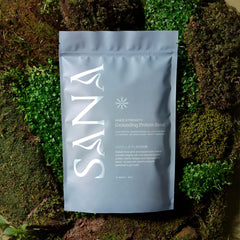
Inside SANA’s Grounding Protein Blends
Every ingredient in our Grounding Protein Blend has been chosen with purpose.
Our Vanilla protein blend contains eight ingredients: whey protein concentrate and whey protein isolate, marine collagen peptides, natural flavour, coconut oil powder, hyaluronic acid, DigeZyme® and stevia.
Our Rich Chocolate blend has a similar formulation, with some additional ingredients pertaining to the flavour profile (cocoa and himalayan salt), as well as a small amount of guar gum to support its texture and consistency.
Each serve contains 22.4 to 23.1g of protein (flavour dependent) alongside 2,500mg of marine collagen - with no added sugar or sugar alcohols - and is sweetened with stevia alone.
DigeZyme® is a digestive enzyme complex included as part of our considered, gut-conscious formulation. It contains lactase, which supports the breakdown of lactose - thus reducing the potential for associated bloating.
Add one level scoop to 300–400ml of cold water and shake well. Add more or less water to achieve your desired sweetness level.
An honest note
SANA’s Grounding Protein Blend contains whey, which comes from milk, and marine collagen (which comes from fish), so it isn’t vegan or dairy-free.
We use whey for its complete amino acid profile and bioavailability. If you have a dairy allergy or intolerance, please check the allergen information and seek individual guidance from a qualified healthcare practitioner if you are unsure.
How to make protein work for you
If you’ve found a blend that suits you and things still feel a little heavy, a few gentle adjustments may help.
Slow down. This is where our Mindful Eating ritual comes in. Instead of drinking your shake hurriedly between other tasks, set your phone aside, take a few slow breaths and sip it gradually. This is where a functional blend becomes something more meaningful: a simple moment to pause, nourish yourself and return to your day with intention.
Pair it with movement. Our Grounding Protein Blend is designed to complement your daily movement ritual - after a walk, Pilates, strength training or whatever movement looks like for you. Protein supports muscle recovery and the maintenance of muscle mass, making it a considered addition to your post-movement routine.
Notice how you feel. Everybody responds differently. Pay attention to how you feel after your protein and consider the other factors at play - how quickly you consumed it, what you paired it with and what else you’ve eaten that day. If discomfort continues, speak with your healthcare practitioner.

Look beyond the protein number
If protein powder has left you feeling bloated or uncomfortable, you may not need to dismiss it altogether. Start by looking beyond the protein number on the front of the pack and consider the complete formulation, serving size and your own individual response.
Because the right blend isn’t simply the one with the biggest numbers. It’s one that provides purposeful nourishment, tastes genuinely good and feels easy to return to each day.
Explore SANA’s Grounding Protein range
Some ingredients may not be suitable during pregnancy or breastfeeding, or for people with certain health conditions. Please seek guidance from your GP, naturopath or nutritionist if you are unsure, have an underlying health condition or take medication.