



If you've read our earlier piece on hitting your protein goals during menopause, you'll already know just how important protein becomes during this stage of life.
If your body feels like it's responding differently to the same food, movement and routines that once worked for you, there's a reason.
As oestrogen declines, maintaining muscle becomes more challenging, and your body needs more protein, more regularly, than it did in your thirties.
But knowing you need more protein is one thing. Knowing which protein to choose is another.
Whey or plant? Does collagen count? What ingredients are actually worth looking for on the label, and what's just marketing?
We're here to help you make sense of it all.
In this blog, we'll explore what to look for in a protein powder for women over 50, how different protein sources support the body, and why the type of protein you choose matters during perimenopause, menopause and beyond.
Why the type of protein matters after 50
Protein is made up of amino acids, which your body uses for everything from building and maintaining muscle to supporting the health of your skin, bones and connective tissues.
But not all proteins are created equal.
As oestrogen declines, two things become particularly important when choosing a protein source:
- Leucine. Research suggests that as we get older, our muscles become a little less responsive to protein - something known as anabolic resistance. In simple terms, the quality and amount of protein in each meal begins to matter more. Leucine is the amino acid that acts as the 'switch' for building and maintaining muscle - so getting enough in each serve becomes increasingly important. Not all proteins get there easily.
- Digestibility. A protein you can't absorb well is a protein you don't fully benefit from. Digestive capacity naturally shifts with age and hormonal change, which is why the form of the protein - and what it's paired with - makes a difference to how you feel afterwards.
In other words, it's not just about reaching your daily protein goals. It's about choosing quality protein that helps nourish your body through this next stage of life.
Whey vs plant protein: an honest comparison
When it comes to choosing a protein powder, one of the first decisions you'll face is whether to opt for whey or plant-based protein. Both can have a place in a nourishing diet, but there are some important differences worth understanding.
Whey protein comes from milk and is considered a complete protein - it contains all nine essential amino acids, and it's naturally one of the richest sources of leucine available. It's also absorbed quickly, which is why it's been the most studied protein for muscle maintenance in midlife and older adults. Whey protein isolate has had most of the lactose and fat removed, making it gentler on digestion than whole dairy for many people.
Plant proteins - pea, rice, hemp, soy - are wonderful foods and suit many people beautifully, particularly anyone avoiding dairy. The honest trade-off is that most single plant proteins are lower in leucine and slightly less digestible, so a larger serve is generally needed to match what whey delivers. Well-designed plant blends combine several sources to close that gap.
So, which one should you choose? There's no one-size-fits-all answer.
If dairy doesn't agree with you, a thoughtfully formulated plant blend can be a beautiful choice. If dairy does agree with you, whey is one of the simplest ways to get a complete protein that's naturally rich in leucine.

Does collagen count as protein?
This is one of the questions we hear most often, and the answer is a little more nuanced than you might expect.
Collagen is a protein. In fact, it's the most abundant protein in your body, providing structure to your skin, bones, joints, hair and nails.
However, collagen is not a complete protein. Unlike whey, it's low in several essential amino acids and contains almost no leucine, so it isn't a substitute for a complete protein when muscle maintenance is the goal. What it is rich in are glycine, proline and hydroxyproline - the specific building blocks the body uses to make its own collagen.
That's why collagen for menopause has become such a talking point. As oestrogen declines, the body's collagen production slows, which is part of why skin loses elasticity and joints and bones feel the change. Supplying the raw materials through diet is one gentle way to support the body's own processes.
Marine collagen - sourced from fish - is a type I collagen, the same type that makes up most of the collagen in skin and bone, and its peptides are smaller than bovine collagen, which is thought to support absorption.
So where does collagen fit?
Think of it as a beautiful addition to your protein intake, rather than a replacement. A complete protein helps provide the essential amino acids needed for muscle maintenance, while collagen offers additional amino acids used in the body's connective tissues.
Together, they can form part of a more considered approach to nourishment during menopause and beyond.
What to look for in a protein powder for women over 50
With so many protein powders on the market, it's easy to feel overwhelmed by ingredient lists, nutritional claims and promises of what a product can do for you.
But choosing a nourishing protein powder doesn't need to be complicated.
Here are a few things worth looking for:
- A complete protein as the base. Whey (isolate or concentrate) or a multi-source plant blend. Around 20-25g of protein per serve is a sensible target for a meal-support shake.
- Collagen alongside it, not instead of it. Look for a clearly stated amount rather than simply seeing collagen on the ingredient list. Around 2,000-3,000mg of collagen peptides per serve is a useful reference point.
- Digestive support. Enzymes that help break protein and lactose down make a real difference to how a shake sits, especially if you've noticed protein powders leave you heavy or bloated.
- Minimal ingredients, no added sugar. Sweeteners like stevia or monk fruit are natural alternatives to sugar. Look for a formulation where every ingredient has a clear purpose, rather than a long list of unnecessary fillers and additives.
- Something that supports skin and joints too. Hyaluronic acid is one example - it's naturally present in skin and joint fluid and, like collagen, declines with age.
- A flavour you'll actually enjoy. The best protein powder is one you'll want to return to consistently. Taste isn't an afterthought - it's part of what turns good intentions into a ritual that lasts.

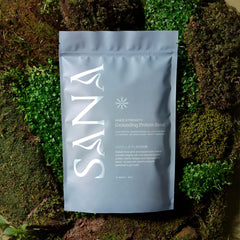
How our Grounding Protein Blend fits
We created our Grounding Protein Blend - in Vanilla and Rich Chocolate flavours - with this stage of life in mind, because Michelle and I were navigating it ourselves when SANA began. We wanted something that brought complete protein, collagen, hyaluronic acid and digestive support together - without making nourishment feel like another complicated task.
Each 30g serve brings together:
- 23.1g of protein from a blend of whey protein concentrate, whey protein isolate - a complete protein, naturally high in leucine - and marine collagen.
- 2,500mg of marine collagen peptides for the raw materials that support skin, bone and joint structure.
- Hyaluronic acid, which the body uses in skin and joint fluid.
- DigeZyme® - a multi-enzyme complex included to support digestion and help the body break down the protein, thus reducing the potential for associated bloating.
- Nothing extra that doesn't need to be there. Coconut oil powder for creaminess, natural flavour and stevia. No added sugar.
It's whey-based, so it won't suit everyone - if you're dairy-free, we'd gently point you towards a well-formulated plant blend instead. But if dairy agrees with you, it's designed to bring complete protein and collagen together in one enjoyable daily blend, rather than asking you to reach for several separate powders.
When to take it
Our previous article '5 Ways to Hit Your Protein Goals During Menopause' covers the timing of protein across the day in detail, so we'll keep this short: the most consistent finding in the research is that spreading protein evenly across meals - rather than loading it into dinner - supports muscle better in midlife.
A protein shake can fit naturally after movement, or as a mid-morning or afternoon bridge between meals when you need something more substantial to carry you through.
A ritual to pair with it
The ritual we pair with Grounding Protein is grounding itself: step outside and, if you can, stand barefoot on grass, sand or soil for a few minutes. Let your breath slow. Notice the surface beneath your feet and the strength in your legs holding you there. Then make your shake, and take a moment to acknowledge that you moved, and that you're nourishing yourself with intention.
Menopause can make the body feel unfamiliar. Strength, energy, appetite and even the way you recover can begin to shift.
Small rituals aren't about trying to control every change. They're a way of coming back to your body - noticing what it needs, nourishing it well and recognising what it's still capable of.
Explore SANA's Grounding Protein Blend and the ritual paired with it.
Your body changing doesn't mean everything needs to change
What nourished you in your thirties may need adjusting in your fifties - and that's not about doing more. It's about understanding what your body needs now.
A little more protein. A little more consistency. Something you genuinely enjoy. And a simple ritual you can return to.
That's a good place to begin.
Protein and menopause: your questions answered
Is whey protein good for menopause?
Whey is a complete protein and one of the richest natural sources of leucine, the amino acid most closely tied to maintaining muscle. That can make whey a useful option during and after menopause, if dairy agrees with you. Whey isolate is the gentler option for sensitive digestion.
Can I just take collagen instead of protein powder?
Collagen provides amino acids used in skin, bones and connective tissues, but it's not a complete protein and contains very little leucine. It works best alongside a complete protein rather than in place of one.
How much protein should be in a serve?
For a meal-support shake, around 20-25g of protein per serve is a sensible target. Our previous blog covers daily totals - most guidance for women over 50 suggests aiming for 1.0-1.2g per kilogram of body weight per day as a starting point.
Is marine collagen better than bovine?
Both provide collagen peptides. Marine collagen is primarily type I - the type most abundant in skin and bone - and its peptides are smaller, which is thought to support absorption. Bovine collagen provides types I and III. Marine is the natural choice for anyone who avoids beef products.
Can I take Grounding Protein if I'm on HRT or other medication?
Grounding Protein is a food, not a medicine, but if you're taking medication or managing a health condition, we always recommend checking with your GP, naturopath or nutritionist first.